

The resignation of Sir Keir Starmer means there is likely to be a pause for thought until September, when a new leader, most likely Andy Burnham, is in place.
In the meantime, house prices recorded their biggest June fall in 14 years as sellers cut asking prices to attract buyers in an increasingly competitive market. However, sales activity remains broadly in line with recent years.
Rightmove says the average asking price of a property coming onto the market fell by 0.6% (£2,113) in June to £376,191 and leaves asking prices 0.5% lower than a year ago.
The property portal says it is the result of sellers adjusting expectations as buyers become more selective and the number of homes available for sale remains at historically high levels for this time of year.
Regional differences, however, remain pronounced. Prices have fallen in southern England and Wales over the past year, while more affordable markets such as the North East and Scotland continue to outperform.
Colleen Babcock, Property Expert at Rightmove, said: “It’s unusual to see a price fall of this size in June, as we would normally expect to see modest price growth at this point in the year.”
She added that a combination of economic uncertainty, the unusually warm weather in May and the high number of homes on the market appeared to be bringing forward the traditionally slower summer market.
The volume of homes available for sale is a major factor behind the softer pricing environment. Rightmove says the number of properties on the market is now at its highest level for this time of year since 2015, giving buyers more choice and increasing competition between sellers.
In practical terms, that means pricing has become more important than it has been for some years. Rightmove says it has resulted in more than a third of newly listed homes failing to find a buyer, underlining the importance of setting realistic expectations from the outset.
The figures, though, are evidence of a market that is cooling rather than declining. Earlier this month Nationwide reported annual house price growth slowing to 1.7% in May from 3.0% the previous month, while Halifax reported annual growth of 0.5%.
Both lenders say it was the result of affordability pressures and economic uncertainty weighing on buyer confidence, but they also highlighted the resilience of household finances and housing demand.
Looking ahead, there are signs, however, that at least some of the economic and political headwinds are beginning to ease. The peace agreement signed by Iran and the US has helped calm financial markets, and the inflationary pressures have eased, creating a more positive outlook for both mortgage rates and housing demand in the second half of this year.
HOUSE PRICES AND STATISTICS
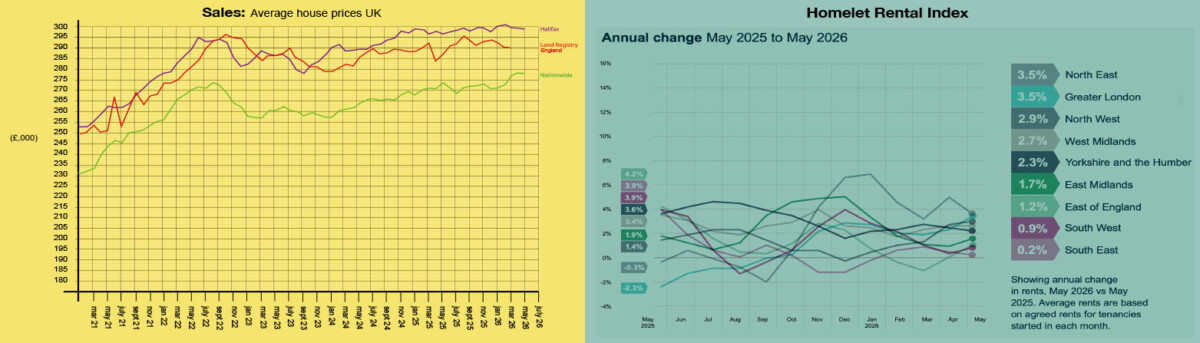
There is a marked deterioration in Rightmove’s figures compared to the other indices, which is the most up-to-date indices, as it is based on asking prices rather than sold prices.
Rightmove: Jun: Avg. price £376,191. Monthly change -0.6%. Annual change -0.5% (asking prices)
Nationwide: May: Avg. price £278,024. Monthly change -0.6%. Annual change +1.7%
Halifax: May: Avg. price £298,806. Monthly change -0.1%. Annual change +0.5%
Land Registry (England): Mar: Avg. price £289,846. Monthly change -0.5%. Annual change -0.6%
Zoopla: Apr: Avg. price £271,900. Annual change +1.5%
BUY-TO-LET
The rental market continues to cool on a national basis, but shortages of available homes mean many tenants are still facing above-average rent increases when they move.
Zoopla reports that average UK rents have risen by 2.1% over the past year to £1,321 a month. However, the portal says the national figure masks significant regional variation, with rents increasing faster than the average in around three-quarters of local markets.
The strongest growth is in the more affordable areas, where rents below £750 a month are rising at close to 5% a year. In contrast, some higher-cost markets are seeing little growth and, in some cases, modest falls where rents hit affordability limits.
Although demand has eased from its pandemic peak, the data shows there are now around 25% fewer homes available, ensuring continued upward pressure on rents.
Competition between renters, however, has fallen considerably, with an average of 5.6 enquiries for every rental property compared with a peak of 15.5 in 2022. It is still, though, well above pre-pandemic norms and is sufficient to support further rental growth..
At the same time, average earnings are growing at around 4% a year, almost double the pace of rental inflation. It is leading to improved affordability for renters and is the third consecutive year in which wage growth has outpaced rent increases.
London is the exception. According to Zoopla, demand in the capital has increased by 6% over the past month as higher mortgage rates continue to delay some first-time buyers from entering the housing market. Rental inflation in the capital has consequently risen to 2.2%, up from 1.9% a year ago.
Looking ahead, Zoopla expects rental inflation to remain between 2% and 3% for the rest of 2026.