
- Design
- Tips
Feng Shui

Over the years, you’ve probably heard plenty about Feng Shui without actually knowing what’s involved. Perhaps you’ve dismissed it as mystical nonsense or been put off by talk of complicated energy maps and ancient Chinese wisdom. The truth is, this 3,000-year-old practice is surprisingly practical—and it might just transform how your home feels.
Feng Shui literally translates to “wind-water,” representing the flow of natural energy through our living spaces. Strip away the mystique and you’re left with something refreshingly simple: arranging your home to feel more balanced, harmonious, and uplifting.
The core principle revolves around Chi—the life force energy that flows through everything. When Chi moves freely through your home, you feel more relaxed and energised. When it gets stuck or rushes too quickly, spaces feel uncomfortable or chaotic. It’s not unlike how a well-designed room naturally draws you in, while a poorly arranged one leaves you feeling unsettled.
The five-element foundation
Feng Shui balances five key elements throughout your home, each bringing specific qualities. Wood represents growth and creativity—think houseplants, wooden furniture, and green tones. Fire embodies energy and passion through candles, fireplaces, or vibrant reds. Earth provides stability via natural materials and earthy colours. Metal brings clarity and precision with metallic finishes and white or grey tones. Water symbolises flow and abundance, whether through actual water features or dark, flowing shapes.
The goal isn’t to have equal amounts of each element, but rather to create balance based on what each room needs. A bedroom might benefit from calming earth and water elements, while a home office could use energising fire and metal.
Your secret weapon: The Bagua Map
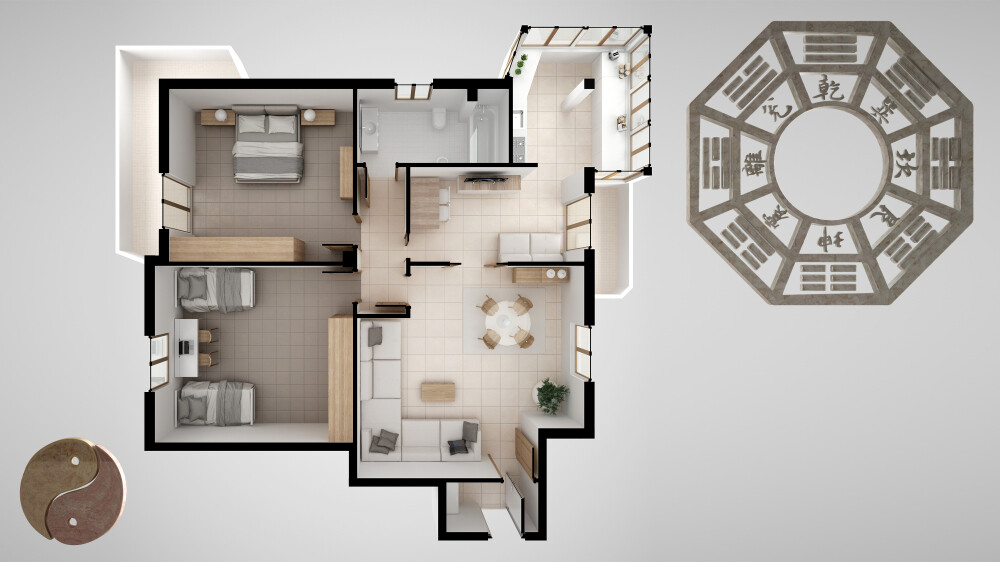
Here’s where Feng Shui gets practical. The Bagua Map divides any space into nine areas, each representing different aspects of life: wealth, fame, relationships, family, health, children, knowledge, career, and helpful people.
Using it couldn’t be simpler. Stand in your room’s doorway and imagine a giant tic-tac-toe grid overlaid on the floor. Want to boost your finances? Focus on the wealth corner—the far left area from the entrance. Looking for love? Work on the relationship zone in the far right corner. It’s essentially like having a roadmap for where to place specific items or colours to enhance different areas of your life.
Room-by-room essentials
Living room: Position your main seating in the “commanding position”—where you can see the entrance while having something solid behind you. This creates an unconscious sense of security. Keep pathways clear for energy flow and add plants for vitality.
Bedroom: Place your bed where you can see the door without being directly in line with it. Avoid mirrors facing the bed, which can be too stimulating for restful sleep. Stick to soft, soothing colours and paired items to encourage harmony.
Kitchen: This room represents nourishment and abundance, so keep it spotless and well-lit. Ensure your stove—symbolising your ability to provide—is in good working order. Try to avoid placing the sink right next to the stove, as this creates conflict between fire and water elements.
Home office: The commanding position is crucial here. Position your desk so you can see the door with a solid wall behind you, preparing you to handle whatever challenges come your way.
Getting started with Feng Shui
Ready to have a go yourself? Begin with decluttering—nothing blocks good energy like mess and excess stuff. Focus on keeping only items that serve a purpose or bring you joy. Next, ensure every room has good lighting, as dark corners harbour stagnant energy.
Add plants throughout your home for instant vitality. Pay special attention to your front door—it’s where energy enters. Keep this area clean, well-lit, and welcoming with a clear path into your home.
For specific goals, use the Bagua Map strategically. Want career advancement? Add something black or dark blue to your career area. Need better relationships? Place paired objects like matching candles in your relationship corner.
The beauty of Feng Shui lies in its flexibility. You don’t need expensive overhauls or rigid adherence to ancient rules. Often, simply repositioning furniture, adding a plant, or introducing specific colours can shift how a space feels.
Trust your instincts about what works in your home. If a room feels better after making changes, you’re on the right track. After all, the best Feng Shui is whatever makes your home feel more like the sanctuary it should be.