


The housing market began 2025 on a cautious but stable footing. Inflation was easing, mortgage rates were slowly coming down, and the base rate had finally begun to peak. Household incomes were improving in real terms, but affordability remained stretched, and buyer confidence was fragile after a prolonged period of economic and political uncertainty.
Much of 2025 was then characterised by speculation about how quickly interest rates would fall. As the year progressed and it became clear that cuts would be gradual rather than rapid, the market settled into a slower rhythm. Activity levels improved somewhat in the more affordable regions, while higher-priced markets remained subdued.
There was, at least initially, an uplift in sentiment following the general election, which helped to stabilise market sentiment, but attention then quickly turned to the Autumn Budget and its implications for homeowners, landlords and first-time buyers. Warnings about tough fiscal decisions and ongoing pressure on public finances led to worries over property taxes, and many homeowners paused their plans once again.
Further base rate reductions did little to ease those concerns, and house price growth slowed sharply. However, as 2025 drew to a close, the budget turned out not to be as bad as many thought, and activity picked up, particularly among first-time buyers and movers in lower-value markets.
Over the course of the year, transaction volumes remained below long-term averages, but pricing was broadly stable, and confidence had begun to improve as we headed into 2026.
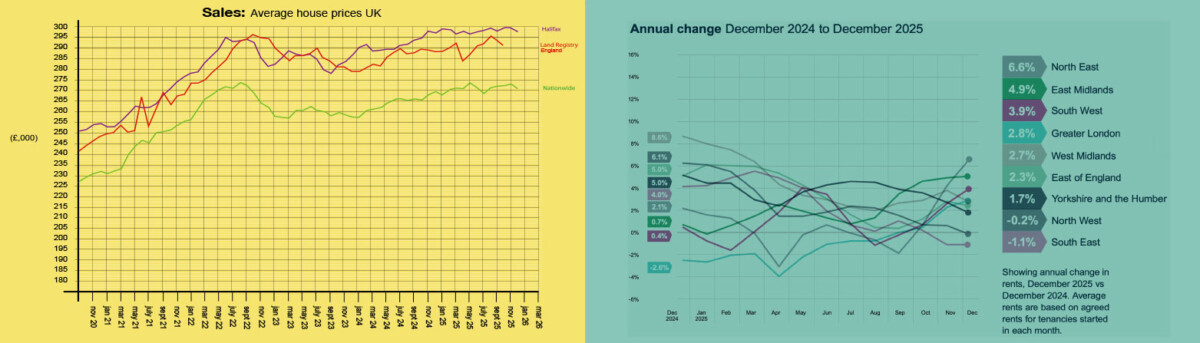
According to the major house price indices, average UK house prices ended 2025 slightly higher than a year earlier, with modest annual growth overall. Northern regions and parts of Scotland performed more strongly, while London and the South East lagged behind and, in some cases, recorded small annual falls.
The housing market has, reportedly, had a busy start to 2026, but what is on the cards for the housing market for the rest of the year? Unlike in recent years, the outlook is finally a little more settled. Most commentators are forecasting modest price growth rather than rapid gains, with the market expected to remain sensitive to mortgage price movements, employment conditions and household affordability.
2025: the facts
Nationwide: Dec 24 to Dec 25: National c.£271,000 +0.5%. London c.£525,000 -0.5%
Halifax: Dec 24 to Dec 25: National c.£298,000 +0.3%.
Land Registry: Oct 24 to Oct 25: National c.£270,000 +1.5%. London c.£545,000 -0.3%
Zoopla: Nov 24 to Nov 25: National £270,300 +1.1%. London £529,400 -0.6%
Rightmove: Dec 24 to Dec 25: National £358,000 +1.2%. London £660,000 -0.5% (asking prices).
The predictions
Please note – where possible, comparative figures for 2025 are from the company’s own indices.
Nationwide
Last year, Nationwide expected prices to be broadly flat. In the event, its data shows it was a year of modest growth. Looking ahead to 2026, the lender expects house prices to rise in the region of 2% to 4%, on the assumption that mortgage rates continue to gradually ease.
Halifax
Halifax had previously warned of potential price falls, but prices instead proved more resilient at +0.3%. For 2026, it expects low to mid single-digit price growth, supported by improving affordability and stable employment.
Zoopla
Zoopla predicted subdued conditions through 2025, which largely materialised, with prices up by 1.1%. For 2026, the portal expects modest house price growth of around 2%, with stronger performances in the more affordable regions.
Rightmove
Rightmove was a bit over-optimistic last year with their prediction of 4% growth, against a final figure of +1.2%. Their asking price data suggests confidence is slowly returning. For 2026, they are expecting asking prices to rise by around 3% nationally, with significant variations by region.
Rental market
Most commentators expected rental growth to slow in 2025 after several years of rapid increases. And they were right, rent rises did moderate, with annual growth falling back to low single-digit levels across much of the country.
There was also increasing evidence that rents were approaching the limits of affordability for many tenants. While demand remained strong, particularly in urban centres, higher living costs and slower wage growth began to constrain any increases.
According to Homelet’s Rental Index, the average UK rent ended the year at £1,317pcm, which was an annual increase of 2.6%. In London, the average was £2,129, wiuth a 2.8% annual rise.
Looking ahead, concerns remain that future regulatory changes could reduce supply, but so far, there is little evidence of a large-scale landlord exit. The rental market has, instead, continued to gradually rebalance demand and supply.
It means most rental indices suggest rents are likely to continue rising in 2026, but at a much more modest pace than in previous years, with growth expected to average around 2% nationally.