
- Improving
- Prepare for sale
Bringing in the light

There’s a good reason people often use the words ‘light’ and ‘airy’ when they describe a house they like. Natural light has a very real effect on both our mood and our electricity bills. With our constantly grey skies, we simply can’t get enough of it. So, what can you do if you’ve got some dark spots in your house?
The standard advice is to add a mirror and paint everything white. It’s good advice, but there’s a whole range of other things you can do, too. Some of them are more radical and expensive than others but they can make such a difference to the enjoyment (and saleability) of your house that they are all worthy of serious consideration.
The first step in improving natural light is to ascertain why the room is so dark in the first place. It may sound obvious, but you could spend a lot of time and effort painting everything white and changing all the curtains, when the real problem is a small window. You might be able to produce a far more dramatic improvement by simply increasing the size of it. You could even add another one and then you could paint your room whatever colour you liked.
Most people dismiss it as an option, as they think it will be too messy and expensive, but it’s not as costly as you might think. Making a hole in an exterior wall and adding a small window should cost under £1,000 (depending on the size of window and the type of wall structure). Enlarging an existing one may cost a little more, but it’s still not much different from the cost of buying a sofa. You may need planning permission and you should also be careful that it fits in with the design of the property’s exterior, as a poorly sited window can reduce the value of a property. If that extra window overlooks your neighbour, don’t despair, the planners will sometimes allow it on condition you use obscured glass.
Another surprisingly common cause of dark rooms is obstructions, both internal and external. An overgrown shrub or tree can easily prevent direct sunlight from entering the room. Pruning is relatively cheap and simple. And remember, a tall tree can cast a shadow from some considerable distance, so don’t just prune ones that are right in front of the window. Talking of external factors, reflected light from outside can also play a huge part in lightening a room. If the room’s window looks directly onto a wall, paint it white. It can even make a difference if you use light coloured materials outside the window, too,such as light coloured gravel.
Something else you should also consider is where you place your furniture. Try to leave as clear a path for natural light as possible. If you place a dark wardrobe or bookshelf against a wall that normally gets a lot of light, it will darken the whole room. Move it to another wall and you’ll allow the light to bounce around. Better still, you could swap it for something lighter. As a general rule, if you want to maximise the light, you should try and avoid dark furniture in small rooms.
Some of the darkest rooms in the house are often bathrooms, especially in terraced houses. Lots of them have no external walls at all, so windows are not an option. Instead, they must rely on expensive electric light. The logical solution is to put in a rooflight, but if that is not possible, you can use a light tube. A light tube takes light from outside the house and funnels it down a reflective tube into a diffuser. The tube can be bent, so it is a highly flexible system and means you can get light into even the trickiest places. It gives a far more natural light than an electric bulb. It costs around £500 to install one, but after that, the light it produces is free.
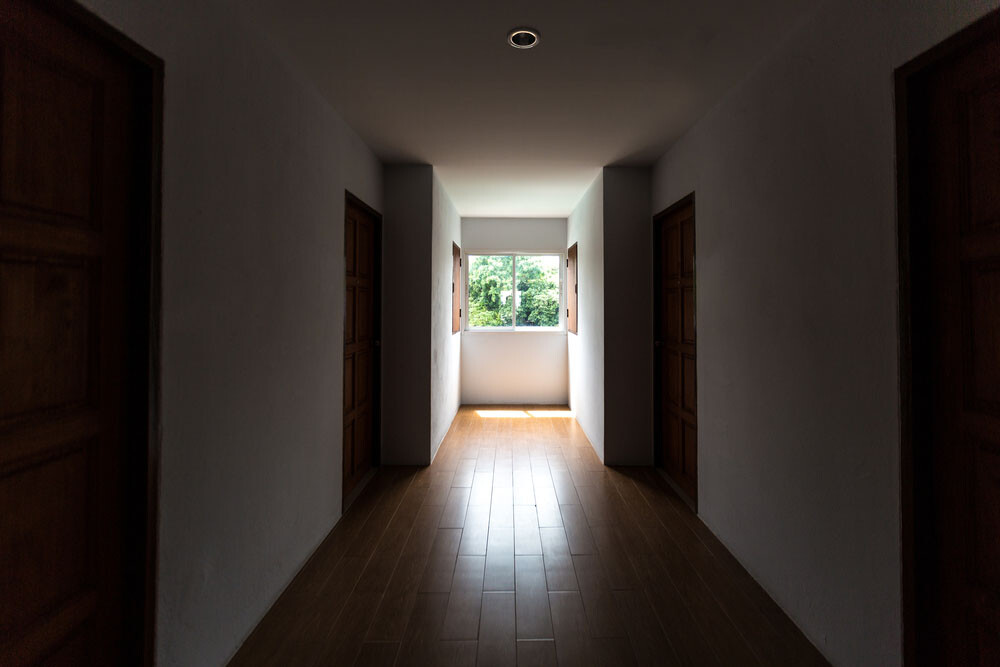
If you’ve got a dark and dingy hallway or landing, you can improve them massively with the addition of a skylight at the top of the stairs. As an added bonus, because most rooms are adjoined to them, it’s the sort of change that can increase light levels throughout the house.
Small rooms and low ceilings are another potential problem area. Unless it’s a bedroom or bathroom, it’s best to try and open them up by removing a wall or two. Not only does it make them lighter, but since the trend is for large living spaces, it also makes the house more desirable in the process. You could also consider adding a glazed extension or a conservatory.
If you are on a more restrictive budget or are trying to quickly dress the house for sale, there are a number of simpler things you can do. Reflective surfaces are very good for increasing light levels and that includes floors. Light bounces off hard floors far better than it does off carpets. De-cluttering also helps, but if you paint the walls a light colour, swap the heavy curtains for some wispy drapes and put a white throw on the sofa at the same time, you’ll completely transform the room. And if all else fails, hidden light sources are the closest you can get to replicating natural daylight and are excellent for illuminating any stubbornly dark areas. And don’t forget those mirrors.