


Rightmove reports the UK housing market has had its strongest start to the year since 2020. However, the escalating crisis in the Middle East is generating fresh uncertainty over inflation and energy prices, which could push borrowing costs higher. It may be some time before it becomes clear how long the conflict will last, how much it may fuel inflation, and whether that will ultimately feed through to the housing market.
In the meantime, the latest housing market data shows that prices have steadied following January’s record start to the year. The average asking price of newly listed homes slipped by just £12 to £368,019 during February, leaving prices broadly flat. However, because of January’s surge, asking prices are still up 2.8% since December.
Before the Gulf conflict began, improvements in mortgage affordability had been giving the market a boost. The average two-year fixed mortgage rate was around 4.28% just a week earlier, which was close to its lowest level since the 2022 mini-Budget and well below the 4.96% recorded a year earlier. At the same time, the number of homes coming onto the market has increased markedly, with properties for sale now at an eleven-year high for this time of year.
Colleen Babcock, property expert at Rightmove, said:
“The average asking price of newly listed homes has held steady this month following January’s record rise. With plenty of homes for sale, sellers are recognising that pricing competitively is key if they want to secure a buyer.”
The other main house price indices reveal a similar pattern of modest growth rather than a rapid rebound. Nationwide recorded a 0.3% monthly rise in February, leaving annual house price growth unchanged at 1.0%, with the average UK home now valued at £273,176.
Amanda Bryden, Head of Mortgages at Halifax, said:
“The housing market built on its steady start to the year, with prices rising by 0.3% in February and annual growth edging up to 1.3%.
Geopolitical uncertainties, however, seem set to influence the outlook for inflation and the wider economy, meaning markets now anticipate a more gradual path for interest-rate reductions.”
Zoopla’s latest index shows the average UK property price is currently at £269,900, up 1.3% over the past year. However, it also shows that supply is rising, with around 6% more homes available for sale than a year ago.
Regional differences remain pronounced. The more affordable northern markets are continuing to see stronger price growth, while the higher-value southern regions remain subdued as affordability pressures and higher stamp duty costs continue to weigh on demand.
HOUSE PRICES AND STATISTICS
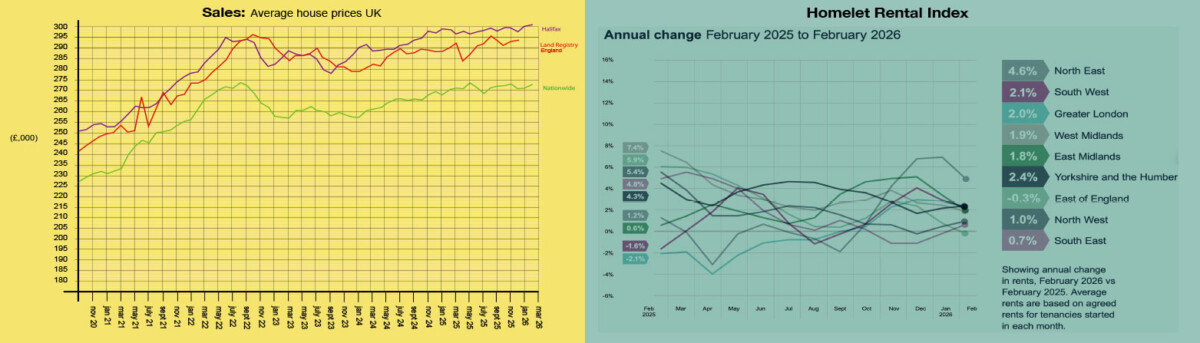
The latest indices all show a broadly stable housing market, with prices moving only marginally month-to-month.
Rightmove: Feb: Avg. price £368,019. Monthly change 0.0%. Annual change 0.0% (asking prices)
Nationwide: Feb: Avg. price £273,176. Monthly change +0.3%. Annual change +1.0%
Halifax: Feb: Avg. price £301,151. Monthly change +0.3%. Annual change +1.3%
Land Registry (England): Dec: Avg. price 293,865. Monthly change -0.7%. Annual change +1.7%
Zoopla: Jan: Avg. price £269,900. Annual change +1.3%
BUY-TO-LET
The rental market remained broadly flat in February, with HomeLet reporting a slight easing in rents as supply improved and tenant demand cooled.
Average UK rents slipped to £1,301 in February, though they remain 2.0% higher than a year ago. Excluding London, rents edged up by 0.2% over the month to £1,120, with annual growth of 1.8%.
Improvements in mortgage affordability have been enabling more renters to gradually move onto the housing ladder, easing pressure in the rental market after several years of rapid rent inflation. At the same time, supply levels have improved as net migration has fallen, helping to moderate rent increases in many regions.
Rental growth continues to be strongest in more affordable markets. In February, rents rose by 5.1% in the North East, 4.6% in Scotland and 3.1% in Northern Ireland, while higher-cost southern regions are seeing much flatter rental trends.
London has the country’s most stretched affordability. When that is combined with improved supply, it has limited landlords’ ability to continue pushing rents higher and has led to a sharp cooling of the capital’s rental market. The average rents fell by 0.5% in February to £2,067, although they are still around 2.0% higher than a year earlier.