

The housing market remained subdued during August, with sellers having to become increasingly realistic on price as buyers found themselves with more homes to choose from.
Rightmove recorded a 2% fall in the average asking price of a newly listed property during the month to £364,999, the largest August drop since 2018 and considerably more than the ten-year average fall of 1.3%.
The decline came as the number of properties available for sale reached a 12-year high for this time of year, increasing competition between sellers. Average asking prices are now 1% lower than a year ago.
There are, however, growing regional disparities. Rightmove’s asking-price data shows prices in northern England were up 1.5% over the past year compared with a 1.8% fall in the South and a 3.1% fall in London.
Some of the data coming from the other main housing market indices paint a slightly different picture.
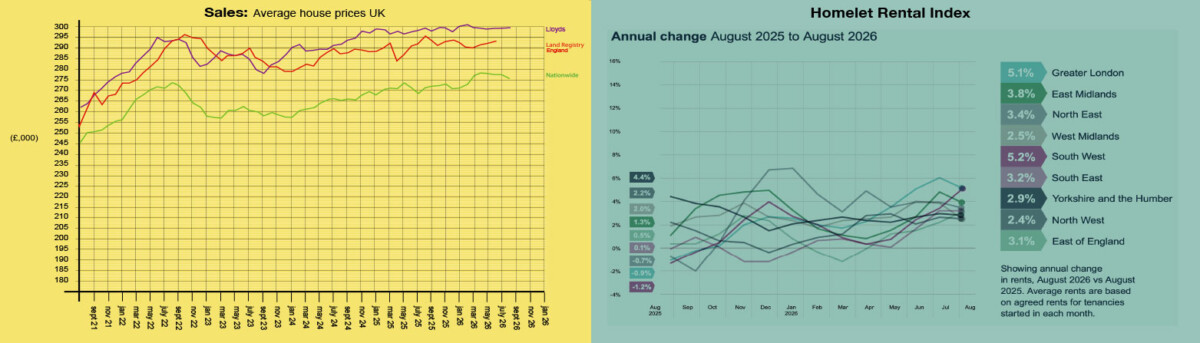
Nationwide reported a 0.2% rise in house prices during August, with annual growth edging up from 1.4% to 1.6%. Its average property price was £275,465.
Lloyds, though recorded a 0.2% fall during August to £298,468, following a 0.1% decline in July. This pushed annual growth into negative territory for the first time since November 2023, with prices 0.4% lower than a year ago.
Lloyds’ Mortgages Director Andrew Asaam says: “The housing market has faced a more difficult backdrop in recent months, with the impact of global events on inflation and borrowing costs creating greater economic uncertainty. What we’re not seeing is a rush of homeowners cutting prices. But more are choosing to sit tight, with sellers reluctant to accept offers they feel are too low, while some buyers are waiting to see how conditions develop.
“It’s also important to keep recent price movements in perspective. Average house prices remain around 25% higher than they were at the end of 2019, despite the substantial increase to interest rates seen over recent years.
“The market’s adjustment to higher borrowing costs has been gradual, with wage growth helping to offset some of the pressure on affordability.”
There are tentative signs that the market could pick up as the summer ends. Rightmove recorded what it described as a “mini-Burnham bounce”, with buyer demand rising by 5% since he became Prime Minister on 20 July. Buying activity, however, remains around 10% lower than a year ago.
Rightmove has recently downgraded its forecast for asking prices during 2026 from growth of 2% to somewhere between no change and a 2% fall.
PRICES AND STATISTICS
All the most up-to-date indices lost ground in August, but they are not all in negative territory.
Rightmove: Aug: Avg. price £364,999. Monthly change -2.0%. Annual change -1.0% (asking prices)
Nationwide: Aug: Avg. price £275,465. Monthly change +0.2%. Annual change +1.6%
Lloyds: Aug: Avg. price £298,468. Monthly change -0.2%. Annual change -0.4%
Land Registry (England): June: Avg. price £293,262. Monthly change +0.2%. Annual change +1.8%
Zoopla: July (UK): Avg. price £272,800. Annual change +0.9%
BUY-TO-LET
The rental market is currently moving in the opposite direction to the sales market, with rents rising again during August and London recording some of the strongest growth.
The average rent on a newly agreed tenancy increased by 0.9% during the month to £1,382, according to the latest HomeLet Rental Index. That was the sixth consecutive monthly increase, leaving rents 4.1% higher than a year ago.
In London, average rents increased by 1.4% during August to £2,238 and are now 5.1% higher than a year ago. In comparison, rents outside London rose by 0.8% during the month and 3.4% over the past year.
There are some significant regional differences, with annual rental growth ranging from 5.2% in the South West to a 1% fall in Wales.
According to Zoopla, although tenant demand has eased considerably from the extraordinary levels seen a few years ago, the number of homes available to rent is still 20% to 30% below pre-pandemic levels in every region.
Once more, London is proving an exception, with Zoopla finding it was the only region where rental demand was increasing, up 6%, which the portal linked to higher mortgage rates keeping more people in the rental market.