


January’s figures give the first real glimpse of how the housing market is shaping up in 2026, with Rightmove reporting the largest ever price jump for the month as buyers return after 2025’s budget uncertainty.
Average new seller asking prices rose by 2.8% (+£9,893) to £368,031, the biggest increase for the month since Rightmove began tracking the index 25 years ago. The rebound follows several muted months at the end of 2025. However, supply remains elevated, with the number of homes for sale at their highest January level since 2014 and a third of listings already the subject of price reductions.
Early activity indicators also reveal renewed market confidence. Buyer demand in the two weeks after Christmas rose 57% compared with the fortnight before, while new listings jumped up 81%. Rightmove also recorded its busiest ever Boxing Day for visits to its website. At the same time, Mortgage affordability is improving, with the average two-year fixed rate now at 4.29%, its lowest level since before the 2022 mini-Budget, which is helping support early-year momentum.
Colleen Babcock, property expert at Rightmove, said:
“It’s an encouraging start to the year to see sellers confident enough to list their homes at higher prices after several months of muted price growth last year, coinciding with more potential buyers returning to market.”
The other key indices’ figures point in a similar direction but with more steady growth. Nationwide recorded a 0.3% monthly rise in January and annual growth of 1.0%, while Halifax reported a 0.7% monthly increase and annual growth also at 1.0%.
Amanda Bryden, Head of Mortgages at Halifax, said:
“Wage growth has been outpacing property price inflation since late 2022, steadily improving underlying affordability. That’s a positive trend for buyers, and the long-term health of the market.”
Zoopla’s index, though, reveals the modifying effect rising supply is having on price rises, with the stock of homes for sale now 6% higher than it was a year ago. It’s giving buyers more choice and forcing sellers, particularly in southern England, to price realistically. Northern cities continue to outperform the other regions thanks to better affordability. London, in contrast, remains slightly negative year-on-year.
HOUSE PRICES AND STATISTICS
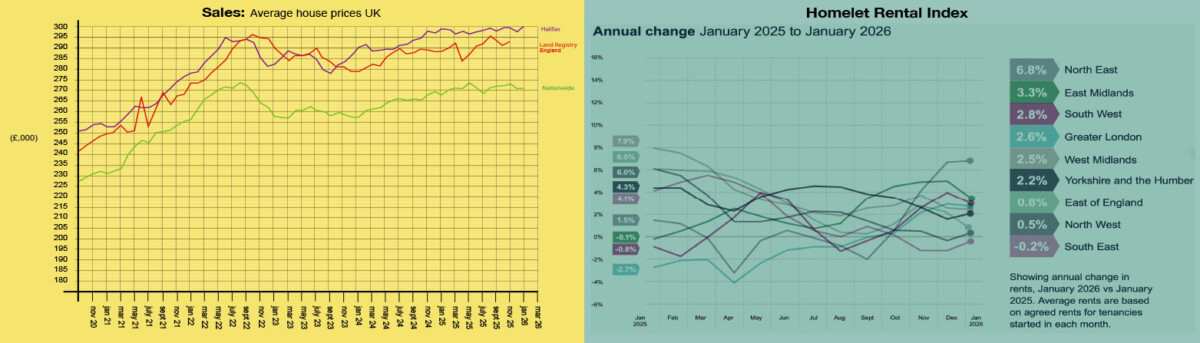
All the indices show a clear January rebound, with prices up between 0.3% and 2.8% from the previous month.
Rightmove: Jan: Avg. price £368,031. Monthly change +2.8%. Annual change +0.5% (asking prices)
Nationwide: Jan: Avg. price £270,873. Monthly change +0.3%. Annual change +1.0%
Halifax: Jan: Avg. price £300,077. Monthly change +0.7%. Annual change +1.0%
Land Registry (England): Nov: Avg. price £293,131. Monthly change +0.4%. Annual change +2.2%
Zoopla: Dec: Avg. price £269,800. Annual change +1.2%
BUY-TO-LET
The rental market softened again in January, with HomeLet reporting a third consecutive monthly fall in agreed rents as supply levels improve and tenant demand cools.
Average UK rents edged down 1.1% in January to £1,302, although they remain 2.4% higher than a year ago. Outside London, rents slipped 0.5% over the month to £1,118, continuing their gradual easing after the high levels of inflation in 2022–23.
Falling net migration has weakened demand at the same time as improved mortgage affordability has enabled more first-time buyers to get off the rental market and onto the housing ladder. It means properties are taking longer to let, staying on the market for an average of 17 days, which is the slowest pace since 2019 and limiting landlords’ ability to push through big rent rises.
As ever, there are some wide regional variations. Rents are rising fastest in more affordable northern (between +3.2% to +4.5%) and Midlands (+2.5% to 3.3%) markets, where there is still room for growth, while rents in higher-cost southern areas are more or less flat. Analysts expect rental inflation to settle to around 2.5% during the year, with affordability gradually improving and the market returning to more typical seasonal patterns.
Rent rises in London, however, are cooling fast. Average rents in the capital fell 2.4% in January and 6.3% below their October peak, although they are still 2.6% higher than a year ago at £2,078. Only a small number of boroughs recorded monthly growth, with outer areas such as Ealing (+9.9%) leading the gains. Homes in the capital are also taking longer to let at 19 days.