



The UK housing market remained surprisingly resilient through April and into May despite higher mortgage costs, global uncertainty and continued pressure on household finances.
Rightmove reports the average asking price of a property coming to market rose by 1.2% in May to £378,304, slightly above the long-term seasonal average for this time of year. Sales agreed were running just 4% below last year, despite borrowing costs remaining elevated.
The latest figures, however, also reveal a widening north-south divide. More affordable northern regions continued to outperform the rest of the country, while parts of southern England and London saw weaker demand and falling prices as higher mortgage costs weighed more heavily on buyers.
According to Rightmove, annual asking prices in the North East rose by 2.7% and the North West recorded growth of 2.6%. In contrast, London prices were down 2.4% year-on-year, and the South East saw a 1.6% decline.
Colleen Babcock, Property Expert at Rightmove, said: “It’s normal to see asking prices pick up as we move through the spring selling season. What’s notable this month is that activity in the market is staying fairly steady, even with ongoing cost-of-living pressures and wider global uncertainty.”
She also warned that sellers were now operating in a far more competitive market, with the number of homes for sale at its highest level for this time of year since 2015.
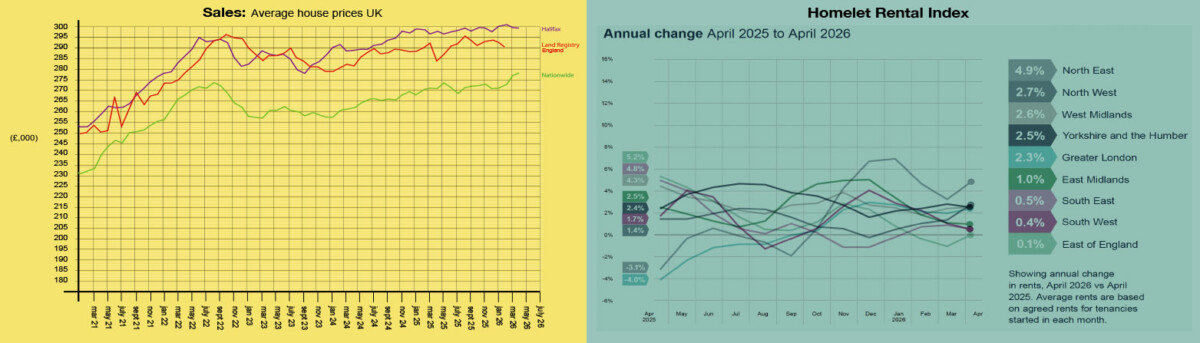
The other housing indices, which are a couple of months behind Rightmove, continue to suggest a market that is slowing rather than declining. Halifax reports average house prices edged down by 0.1% in April, leaving annual growth at 0.4%, while Nationwide reported annual growth strengthening to 3%.
Amanda Bryden, Head of Mortgages at Halifax, says the housing market continues to show “resilience”, while Nationwide Chief Economist Robert Gardner describes the market as “proving surprisingly resilient” despite geopolitical uncertainty and rising energy prices.
Zoopla also reported that homes are taking only one day longer to sell than this time last year, with buyer demand rebounding after Easter.
HOUSE PRICES AND STATISTICS
There is quite a lot of variation in the indices at the moment. The monthly figures range from -0.1% to + 1.2%%, and the annual ones range from -0.3% to +3.0%. This is a reflection of the changing market conditions, with most of the variation occurring between the older and the more up-to-date indices.
Rightmove: May: Avg. price £378,304. Monthly change +1.2%. Annual change -0.3% (asking prices)
Nationwide: Apr: Avg. price £278,880. Monthly change +0.4%. Annual change +3.0%
Halifax: Apr: Avg. price £299,313. Monthly change -0.1%. Annual change +0.4%
Land Registry (England): Feb: Avg. price £290,001. Monthly change +0.2%. Annual change +0.8%
Zoopla: Mar: Avg. price £271,700. Annual change +1.3%
BUY-TO-LET
The rental market showed continued signs of cooling in April as landlords and tenants prepared for the introduction of the Renters’ Rights Act.
New figures from Goodlord and HomeLet suggest rental inflation has slowed sharply compared to the rapid rises seen over the past two years.
Goodlord says the average cost of a rental property in England slipped by 0.6% in April to £1,205 per month, while annual rental growth slowed to 1.7%.
Meanwhile, HomeLet reports average UK rents reaching £1,325 in April, up 2.1% annually, with rents outside London averaging £1,135.
Regional differences remain significant. HomeLet says the strongest annual rental growth was recorded in Northern Ireland, the North East and Scotland, while Goodlord found Greater London continues to record the strongest annual growth in England at 4.8%.
Void periods — the time properties remain empty between tenancies — also increased slightly during April. Goodlord says average voids rose from 22 to 24 days nationally, suggesting some easing in competition between tenants.
Affordability remains severely stretched, though, particularly in London. HomeLet says renters in the UK now spend an average of 32.7% of their income on rent, rising to 38.3% in the capital.
William Reeve, Chief Executive of Goodlord, says the sector was entering “a very different rental market” as the Renters’ Rights Act comes into force.
He adds that the latest figures suggest much of the market had been in a “defensive crouch” ahead of the new legislation.