

June’s house price data is highly contradictory. Rightmove has reported a significant fall in asking prices, and Zoopla recorded weaker buyer activity, but Nationwide and Lloyds both reported house price growth.
The apparent contradiction is largely due to the indices measuring different stages of the buying process. Rightmove’s data is the earliest, as it tracks asking prices; next is Zoopla’s, which is based on buyer demand and agreed sales. Nationwide’s and Lloyds’ data, on the other hand, are based on prices paid and can be several months behind.
The latest Rightmove House Price Index shows the average asking price of a property coming to market fell by 0.6% during June to £376,191, as sellers face increased competition from other listings and more price-sensitive buyers.
Rightmove’s Colleen Babcock says: “It’s unusual to see a price fall of this size in June, as we would normally expect to see modest price growth at this point in the year.
“What’s different this time is a combination of factors, including wider economic uncertainty, the timing of the May bank holiday and unusual heatwave, and the high number of homes on the market, which together appear to be bringing forward the traditionally slower summer market.”
Zoopla’s latest House Price Index also suggests a softening of the market. House price growth slowed to 1.4%, with sales agreed running 7% below the same period last year. The portal says higher mortgage rates and economic uncertainty have reduced buyer activity, although it adds that demand remains broadly in line with longer-term averages.
Nationwide’s figures, though, paint a very different picture. Annual house price growth was up 2.2% in June, up from 1.7% in May, although prices were unchanged on a monthly basis. Looking ahead, the lender added that lower market interest rates would help support housing activity if they are sustained.
Lloyds’ latest House Price Index also reported modest growth. There was a 0.2% monthly increase in June, with annual growth edging up to 0.6%.
Like Nationwide, it said easing borrowing costs should help improve affordability and support demand in the months ahead.
Together, the data suggests the market has slowed but remains resilient, despite the political uncertainty both here and abroad and the elevated mortgage costs. Asking prices and buyer demand may have softened a little earlier than usual for this time of year, but completed sale prices are holding steady.
According to Nationwide’s Robert Gardner: “If market interest rates continue to moderate, as we and most other analysts expect, activity is likely to strengthen somewhat in the quarters ahead.”
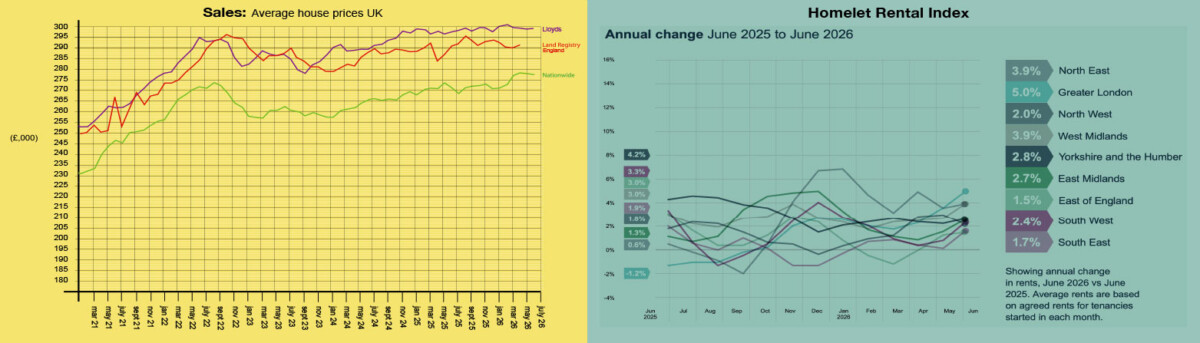
HOUSE PRICES AND STATISTICS
There was some marked variation between the indices in June, with the more up-to-date (Rightmove and Zoopla) showing the first signs of a summer slowdown.The Land Registry figures, though, are lagging some way behind.
Rightmove: Jun: Avg. price £376,191. Monthly change -0.6%. Annual change -0.5% (asking prices)
Nationwide: June: Avg. price £277,484. Monthly change 0.0%. Annual change +1.7%
Lloyds: June: Avg. price £299,330. Monthly change +0.2%. Annual change +0.6%
Land Registry (England): Apr: Avg. price £291,445. Monthly change +0.6%. Annual change 3.9%
Zoopla: May (UK): Avg. price £272,300. Annual change +1.4%
BUY-TO-LET
According to Zoopla’s Q2 Rental Market Report, new lets averaged £1,287 per month. That’s 2.1% higher than a year ago, although annual rental growth has slowed to 2.1% from 2.6% in the same period in 2025.
Competition for rental homes, however, has eased, with an average of 5.6 enquiries per property, which is well below the peak reached in 2022. Demand, though, is still above pre-pandemic levels and rental supply remains significantly constrained, with every region still having fewer homes available to rent than they did in 2019.
The portal says the national figure masks a two-speed market. In more affordable areas, where average rents are below £750 per month, rents are rising by almost 5% a year – more than double the national average. In contrast, areas where rents exceed £1,250 per month are recording growth at or below the UK average as affordability limits are reached.
There are also significant regional differences, with rental growth weakest in the West Midlands at just 0.4% and strongest in the North East at 3.8%.
In London, a 6% rise in rental demand has pushed annual rental growth up to 2.2%, with average rents hitting £2,249 per month. Zoopla says this is because higher mortgage rates are making it harder for first-time buyers to exit the rental sector.
Looking ahead, Richard Donnell, Executive Director at Zoopla, says: “We expect rental inflation of 2% to 3% over the remainder of 2026. This would mark the third consecutive year in which earnings have outpaced rents, continuing a gradual improvement in affordability that began in 2024.”