

The housing market has been a little quieter than usual so far this summer, with buyers finding plenty of reasons to turn their attention elsewhere.
The World Cup, unusually hot weather and the traditional summer holiday season have all taken their toll on activity, while political uncertainty and higher mortgage rates have given buyers yet more reasons to sit on their hands.
At the same time, uncertainty over Burnham’s approach to tax and housing is making buyers cautious as they wait to see what is in his first Budget in October.
Rightmove’s latest House Price Index shows the average asking price of a newly listed home fell by 1% during July to £372,359. A summer fall is normal, but this was considerably larger than the average July drop of 0.2% over the past ten years.
The hot weather in particular seems to have had an effect on buyer behaviour. Rightmove recorded an 8% drop in buyer demand during May’s heatwave, followed by falls of 6% during June’s and 4% during the latest spell of hot weather in July.
Buyers now have plenty of properties to choose from, too, with the number of homes available for sale close to a 12-year high for this time of year. Sales agreed during the first half of 2026 were 6% down on the same period last year, although they were level with 2024.
Rightmove’s Colleen Babcock says: “This month’s larger-than-normal price fall reflects the reality of a market where buyers have plenty of choice and sellers are having to work harder to stand out and attract them.”
Despite the quieter market, however, there is little evidence of any significant fall in house prices. Nationwide recorded a 0.1% rise during July, taking the average price to £277,542, although annual growth eased from 2.2% to 1.8%.
Lloyds reported an even flatter picture, with prices unchanged during July and annual growth slowing to just 0.1%.
As ever, there are some wide regional variations. Lloyds recorded the strongest annual growth in Northern Ireland at 7.4%, while prices fell by 2% in the South East and 1.3% in London. Northern England generally performed better, with prices up 2.8% in the North East and 2.1% in the North West.
Looking ahead, there are some causes for optimism. Wages are rising faster than house prices, easing affordability, unemployment remains low and, in the autumn, the Budget uncertainty will be over.
HOUSE PRICES AND STATISTICS
July was a relatively quiet month for the housing market, with prices falling in a number of the indices, but not all, as sellers competed for buyers’ attention and activity remained subdued.
Rightmove: July: Avg. price £372,359. Monthly change -1.0%. Annual change -0.4% (asking prices)
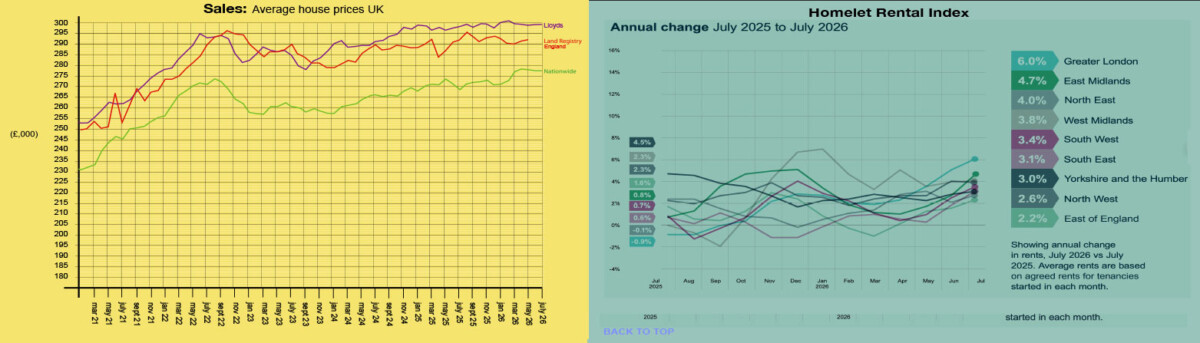
Nationwide: July: Avg. price £277,542. Monthly change +0.1%. Annual change +1.8%
Lloyds: July: Avg. price £299,253. Monthly change 0.0%. Annual change +0.1%
Land Registry (England): Apr: Avg. price £292,095. Monthly change +0.1%. Annual change +2.3%
Zoopla: June (UK): Avg. price £272,800. Annual change +1.3%
BUY-TO-LET
Rental growth picked up again in July, with rents on newly agreed tenancies rising at their fastest annual rate for almost two years.
According to the latest HomeLet Rental Index, the average UK rent rose by 1.2% during July to £1,369, pushing annual growth up to 4.3%. It was the fifth consecutive month in which rents increased.
The rise comes as increases in wages are making rents more affordable. Tenants starting new tenancies spent an average of 32.4% of their income on rent during July, down from 32.7% in June, with the majority of regions recording an improvement in affordability over the past year.
Supply levels, however, remain under pressure. Rightmove reported that the number of homes available to rent during the second quarter was 1% lower than a year ago, the first annual fall in rental supply since 2022. This was largely due to fewer new properties coming onto the market.
London has seen some of the strongest growth, with average rents up 1.2% during July and 6% over the past year to £2,207. That’s now close to the previous peak of £2,218 reached in October 2025, with 18 of the capital’s 21 areas recording annual rental growth.
There are some significant regional variations. In the East Midlands rents increased by 4.7% annually, while the North East recorded growth of 4%. Wales, by contrast, saw rents rise by just 0.1% over the year. Northern Ireland was the only region to record a monthly fall in July, although rents remain 3.1% higher than a year ago.
It’s been a sharp turnaround from last month, when rental growth was slowing as competition between tenants eased.
Whether this new spike in rental costs is linked to the introduction of the Renters’ Rights Act and landlords exiting the market remains to be seen.